Full Cycle Recruiting: The 7 Stages, Pros and Cons
What full cycle recruiting is, the seven stages from intake to close, how it compares with split recruiting, and when each model fits your team.
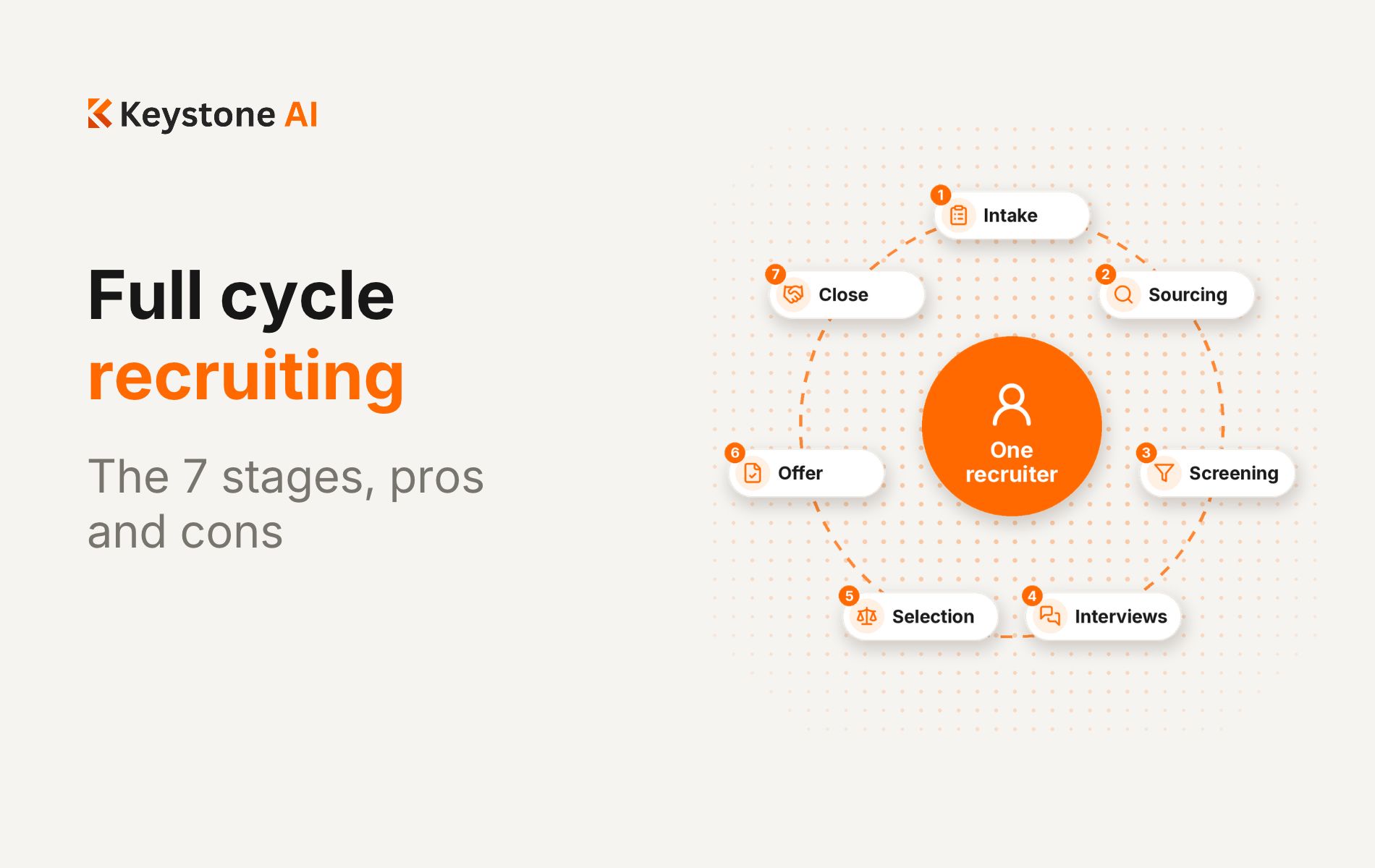
Full cycle recruiting is a hiring model where one recruiter, or one small team, manages every step of a hire, from the first conversation with the hiring manager to the accepted offer. The same person sources, screens, coordinates interviews, negotiates and closes. The alternative is a split model, where sourcers, screeners and closers each handle one stage.
This guide explains the seven stages, compares full cycle with split models, and shows when each one fits.
The short version
- What it is: one recruiter owns the whole hiring process for a role.
- Best for: small and mid-size teams, senior or specialist roles, and teams that want a consistent candidate experience.
- Main trade-off: strong ownership and context, but each recruiter handles fewer roles because they carry every stage.
- Where it breaks: high-volume hiring, where specializing by stage is faster.
What is full cycle recruiting?
Full cycle recruiting puts the entire recruitment process in one pair of hands. A full cycle recruiter might open a role on Monday with a hiring manager, search for candidates on Tuesday, run screening calls on Wednesday and coordinate offers a few weeks later. The recruiter is the single point of contact for both the hiring manager and the candidate.
The term is common in agencies and in-house teams. In an agency, it often describes a recruiter who also does business development for the client. In-house, it usually means the recruiter isn't limited to sourcing or coordinating.
What are the stages of full cycle recruiting?
1. Intake and role definition
The recruiter meets the hiring manager to agree on the role, must-have skills, salary range, timeline and interview plan. A weak intake causes most of the rework later on. Agree on what a good candidate looks like and write it down.
2. Sourcing
The recruiter finds candidates through job posts, referrals, databases, outreach and talent communities. For harder roles, active outreach matters more than postings. If you already know where your key skills sit in the market, talent mapping makes this stage much faster.
3. Screening
The recruiter reviews applications and holds short calls to check skills, motivation, location and pay expectations. The goal is a shortlist the hiring manager would be glad to meet.
4. Interviewing
The recruiter schedules interviews, briefs interviewers, collects structured feedback and keeps candidates informed. Slow scheduling and silence are common reasons candidates withdraw.
5. Selection and references
The recruiter helps the team compare finalists against the agreed criteria, runs reference and background checks, and prepares a recommendation.
6. Offer and negotiation
The recruiter builds the offer, manages the negotiation and handles counteroffers. Because they've spoken to the candidate throughout, they usually know what will matter most.
7. Close and handover
After acceptance, the recruiter manages notice periods, pre-boarding paperwork and the handover to HR or the hiring manager for onboarding. Staying in touch until day one reduces drop-out between offer and start.
Full cycle recruiting vs. split recruiting
- Ownership: full cycle has one recruiter per role. Split has different people per stage.
- Candidate experience: full cycle gives candidates one consistent contact. Split adds handoffs between people.
- Speed on one role: full cycle depends on one person's capacity. In a split model, stages can run in parallel.
- Volume capacity: lower per recruiter in full cycle, higher per team in a split model.
- Skills needed: full cycle needs broad skills. Split needs deep skills in one stage.
- Context loss: low in full cycle, higher at each handoff in a split model.
Neither model is better in general. Full cycle suits teams that hire fewer, more complex roles. Split models suit teams that hire many similar roles at pace, such as seasonal or volume hiring.
What are the pros and cons?
Pros
- Fewer handoffs, so less lost context.
- A single point of contact builds trust with candidates and hiring managers.
- Recruiters learn the full process and the market, which helps them advise managers.
- It's simpler to organize in a small team.
Cons
- Recruiters are stretched across many tasks, and each stage needs different skills.
- Throughput per recruiter is lower than in a specialized model.
- Quality can vary between recruiters, because each person runs their own process.
- Time-consuming sourcing can crowd out candidate care, or the other way around.
When should you choose full cycle recruiting?
Choose it when:
- you hire a modest number of roles and each one is different;
- the roles are senior or specialist and need relationship-building;
- your team is small and can't staff separate sourcer and coordinator roles;
- you want one accountable person per hire.
Consider a split model, or a hybrid, when you hire large numbers of similar roles, or when sourcing is so heavy that it blocks everything else.
How can technology help a full cycle recruiter?
The heaviest load in full cycle recruiting is the manual work: searching, screening, scheduling and keeping everyone updated. Tools can take on part of it. An ATS tracks stages and communication, scheduling tools remove the back-and-forth, and sourcing platforms help build the first shortlist. For a wider view of the options, see our guides to recruitment technology and talent acquisition software.
Keystone AI, our product, takes on the early stages. Its AI agents source and rank candidates, run outreach and conduct voice or video interviews. Recruiters then review the top candidates, and you can finish the hire with a Keystone AI consultant or with your own team in-house. That way the recruiter keeps the stages where people matter most: intake, interviews, judgment and closing. Here's how Keystone AI works.
How do you measure full cycle recruiting?
Track the whole process and each stage:
- Time to fill, and days spent in each stage
- Stage conversion, from screened to interviewed to offered to hired
- Offer acceptance rate
- Hiring manager satisfaction
- Candidate satisfaction
- Cost per hire
Compare recruiters carefully. Roles differ in difficulty, so judge each recruiter against roles of similar difficulty.
Frequently asked questions
A full cycle recruiter handles every stage of a hire: intake, sourcing, screening, interviewing, selection, offer and close.
The terms are used interchangeably. Both describe one recruiter owning the process from intake to accepted offer.
It depends on volume and role type. Full cycle fits fewer, complex roles. Specialized models fit high-volume hiring.
Sourcing, interviewing, stakeholder management, negotiation, basic data skills and knowledge of employment rules in the places they hire.
It varies widely with role difficulty and tools. Agree on a workload target with your team and adjust it using your own time-to-fill data.
Not entirely. AI can support sourcing, screening and scheduling. Intake, judgment, relationships and negotiation still need a person.
Where to start
- Map your current process against the seven stages and note who owns each one.
- Pick the stage that causes the most delay and fix it first.
- Decide whether full cycle, split or a hybrid fits your hiring volume.
- If sourcing is the stage holding your recruiters back, look at how AI can take on the early stages.
- Candidate Sourcing
- Candidate Screening
- Recruitment Automation
- Human in the Loop